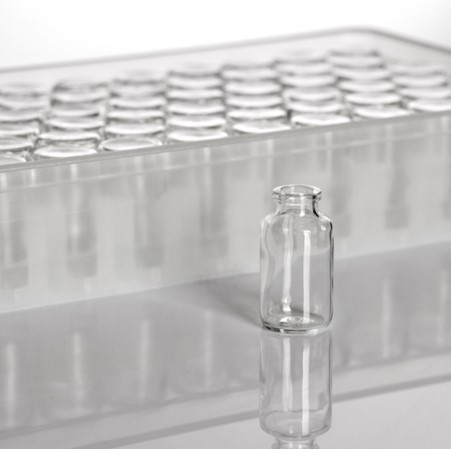
Will vial suppliers be able to meet demand running into billions of units?
Source: Les Echos - Karl De Meyer - 30/11/2020 - https://www.lesechos.fr/weekend/business-story/schott-le-passeur-du-vacc...
All around the world, the pharmaceutical groups furthest ahead in developing a Covid-19 vaccine have started filling (tens of) thousands of vials, without waiting for approval from the major regulators – the Food and Drug Administration in the United States and the European Medicines Agency in Europe. It is a risk, of course, should their product ultimately be rejected, but manufacturers want to be ready to deliver as soon as they get the green light. Last spring, they briefly wondered: would their vial suppliers be able to meet demand running into… billions of units?
The main market players – Germany's Schott and Gerresheimer, Italy's Stevanato, Japan's Nipro and, to a lesser extent, France's SGD – have risen to the challenge. For Schott, the world leader based in Mainz, the capital of Rhineland-Palatinate at the confluence of the Main and the Rhine, it was the perfect moment to honour its founder, Otto Schott, the brilliant chemist who developed borosilicate glass at the end of the 19th century. This boron-containing material offers very high resistance to high temperatures and to most chemicals, with which it interacts very little: ideal for medicines, even though it is also used in heavy industry.
“As early as December 2019-January 2020, we were receiving alerts from China,” recalls Jean-Yves Grandemange, Vice President EMEA Sales for Schott's pharmaceutical systems, who joined the company in 2001 after working at Total. “By February-March, our major pharmaceutical customers were sounding us out on special orders for delivery in 2021.” By happy coincidence, Schott, which claims around 30% of the global market, had already planned to increase its capacity: “In March 2019, we announced investments of 1 billion dollars by 2025. From February 2020, we accelerated this programme.” The group expects to have invested some 500 million dollars by the end of 2021, half of the total budget.
2 billion doses
“At the same time, we have increased production rates by moving from two to three shifts a day in some plants, allowing us to produce 24 hours a day, 7 days a week,” says Jean-Yves Grandemange. Schott plans to produce around 700 million vials for the various vaccines. As each vial contains several doses, the company estimates that it will supply the pharmaceutical industry with some 2 billion doses. To meet demand, Schott will obviously have to ask some of its customers to wait, such as manufacturers of veterinary medicines or cosmetics groups.
The Mainz-based group, which with its 16,200 employees generated sales of 2.2 billion euros in its last financial year, discloses few other figures on its activities, as the company is not listed. Its competitor Gerresheimer, founded in 1864 and based in Düsseldorf, further down the Rhine, is. Its share price has doubled since March, bringing its market capitalisation to 3.2 billion euros for revenue of 1.4 billion euros – which speaks volumes about the market's prospects.
Owned by a foundation
Pharmaceuticals – or more precisely parenteral packaging for the pharmaceutical industry (syringes, vials, ampoules, cartridges made of glass or polymer) – is Schott's core business, although the company is also present in other segments such as household appliances, for example with glass-ceramic hobs and oven doors. Schott also supplies optoelectronic equipment for the automotive and aerospace industries, and components for microscopes and telescopes. The company does indeed have a special relationship with Carl Zeiss, the global giant of precision optics based in Jena, Thuringia, which posts revenue of 6.4 billion euros. Both manufacturers are wholly owned by the Carl Zeiss Foundation.
Why Zeiss, the world leader in optics, can see far ahead
To understand this ownership structure, we need to go back to the 1860s, when the young Otto Schott, fascinated by his father Simon's glassworks, decided to study chemistry, mineralogy and physics in Aachen, Würzburg and then Leipzig, where the university awarded him a doctorate – he would go on to marry his thesis supervisor's daughter. In 1882, he moved to Jena to work with the physicist Ernst Abbe and the optics specialist Carl Zeiss.
In 1884, the three men founded a laboratory that would become Jenaer Glaswerk Schott & Genossen, the forerunner of Schott. They developed borosilicate glass in 1887 and enjoyed great commercial success selling millions of cylinders for oil and gas lamps. In 1919, Otto Schott transferred all his shares to the Carl Zeiss Foundation, created in 1889 by Ernst Abbe, who named it in tribute to their partner, who had died in 1888. The philanthropic entity continues to promote scientific research and education today.
Reunification
In 1945, the Americans, recognising the strategic nature of the company's know-how, urgently relocated its key minds and equipment to what would become West Germany in 1949. The operations that remained in Jena were nationalised by the East German communist regime. After the fall of the Berlin Wall, the Treuhand, the agency responsible for privatising East German assets, sold this combine to Schott in Mainz in the early 1990s – which thus experienced its own reunification.
After the economic crisis of the early 2000s, banks began to show distrust of the unusual legal structure of the Schott-Carl Zeiss empire, prompting management to create two joint-stock companies (Aktiengesellschaften) – but these shares are non-transferable.
Today, both groups are thriving. Alongside ventilator manufacturer Dräger (in Lübeck), Plexiglas producer Röhm (in Darmstadt) and Mainz-based BioNTech, which provided the technology for the Pfizer vaccine , Schott and its competitor Gerresheimer once again illustrate how important it is, in times of severe crisis, to be able to count on a cutting-edge industry capable of rapidly producing crucial equipment.