Container closure integrity evaluation of molded vials stored at -80°C during using laser-based headspace analysis
By Lighthouse Instruments and SGD Pharma
The retention of good container closure integrity (CCI) throughout the lifecycle of a pharmaceutical product is crucial. It guarantees that critical medicines remain effective and that the patient stays safe. From numerous studies it is known however, that storage of pharmaceutics at deep-cold conditions significantly increases the risk of compromising CCI. Moreover, the CCI failures that occur at deep-cold conditions are mostly temporary and cannot be detected with traditional methods such as blue dye testing. Laser-based headspace analysis can detect these temporary defects, and when combined with robust seal quality testing, suitable packaging components and processing conditions can be selected based on robust scientific data.
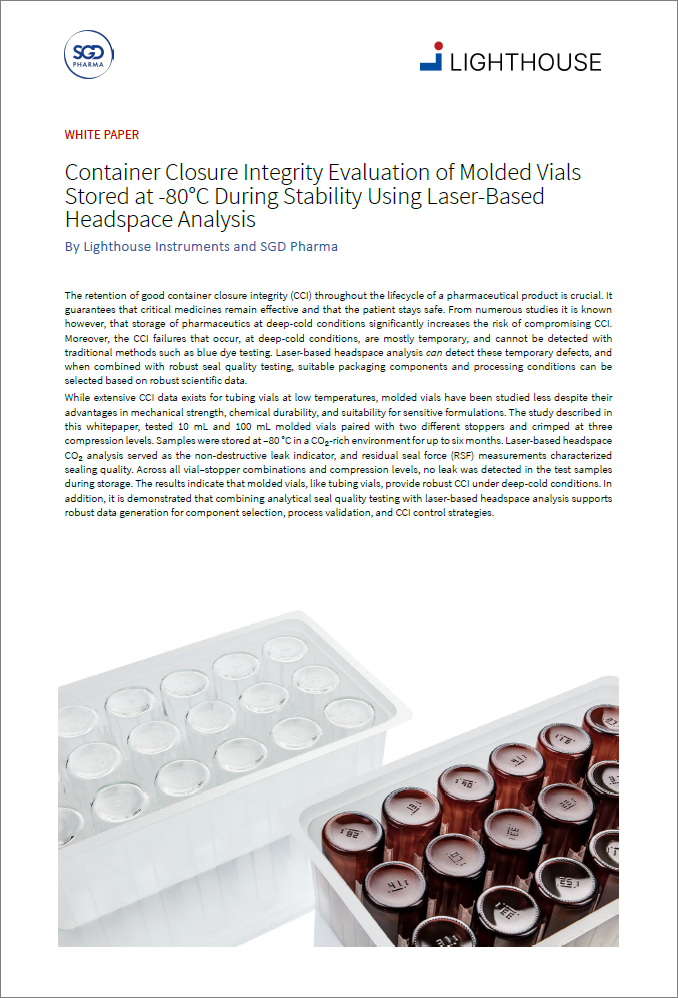
While extensive CCI data exists for tubing vials at low temperatures, molded vials have been studied less despite their advantages in mechanical strength, chemical durability, and suitability for sensitive formulations. The study described in this whitepaper tested 10 mL and 100 mL molded vials paired with two different stoppers and crimped at three compression levels. Samples were stored at –80 °C in a CO₂-rich environment for up to six months. Laser-based headspace CO₂ analysis served as the non-destructive leak indicator, and residual seal force (RSF) measurements characterized sealing quality. Across all vial–stopper combinations and compression levels, no leak was detected in the test samples during storage. The results indicate that molded vials, like tubing vials, provide robust CCI under deep-cold conditions. In addition, it is demonstrated that combining analytical seal quality testing with laser-based headspace analysis supports robust data generation for component selection, process validation, and CCI control strategies.